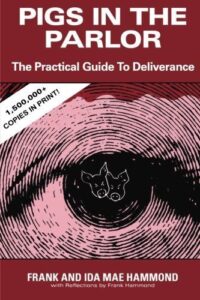
 Amazon’s ranking of book reviews may be a mystery to many readers. I know it was for me. Take, for example, its ranking of “top reviews” of the infamous book Pigs in the Parlor, which teaches that every Christian has at least one demon from which he or she needs to be “delivered.”
Pigs in the Parlor was first published 53 years ago (1973). It is still in print, having sold over 1.5 million copies. In fact, it currently ranks #6 in the Best Sellers in Pentecostal & Charismatic Christianity category on Amazon. A book by Kenneth Hagin, the father of the Word of Faith movement, is #1. Most of the top 100 books in the category appear to be problematic. A Pigs in the Parlor Study Guide and A Manual for Children’s Deliverance, by the same authors Frank and Ida Hammond, are also in the top 100.
As of today, Pigs in the Parlor has 7,465 ratings with an average of 4.8 out of 5. None of the other 100 books in the Pentecostal & Charismatic Christianity category has anywhere close to that many ratings. (Benny Hinn’s Good Morning, Holy Spirit, which I reviewed shortly after it came out, has 4,937 ratings.) It also has 1,146 reviews, meaning comments left by customers. Again, this is more reviews than any other book in the category (Hinn’s book has slightly fewer, currently 1,004 reviews).
Finding my review
In 2004, I wrote a scathing review of Pigs in the Parlor entitled “A classic of deliverance-ministry nonsense” and posted it on Amazon. At the bottom of the review, Amazon has an auto-generated statement that “179 people found this helpful.” Yet my review is extremely difficult to find.
Amazon does not allow you to scroll through all of the reviews. After scrolling through the first hundred “top reviews,” I still had not seen my review. I found that I could see more reviews only by using various filters. The one really useful criterion is not an available filter, and that is how many people found a review helpful. There’s no way to search for the most helpful reviews! In the top hundred reviews, I found only two that more people had found helpful than my review.
There were two ways I could find my review. The first was to search all of the one-star reviews; mine came up at #12 (out of 47 total). The other was to search what Amazon calls “critical reviews” (it wasn’t easy to find this category, since it is a choice under “All stars”). My review came up at #41 on that list (out of 86 total).
Why some reviews rank higher than others
There appear to be only two important criteria determining how highly a review is ranked. (These two criteria are explained briefly in a drop-down link called “How customer reviews and ratings work.”) The first factor is whether the book was purchased through Amazon. This is an understandable criterion since it is an easy, automated way to avoid giving credence to reviews of books the reviewers never read. Of course, people buy books (and other products) from sellers other than Amazon. They also read books checked out from libraries. As a result, the criterion downgrades reviews by people who really did read the book.
On the other hand, one does not actually need to read the book to have one’s review ranked highly. A review that made the top 20 gave the book five stars and comments, “I haven’t stated [sic] this book yet. It is on my list to start this weekend. But this book comes highly recommended from several people in my church. Can’t wait to start it.” Since I didn’t purchase the book from Amazon, my review is downgraded in its ranking, while the “review” in which the reviewer admits he didn’t read the book is ranked very highly.
The other criterion is how recently the review was posted, which is useless because you already have the option to list the reviews by how recent they are. How long ago someone wrote a review of a book shouldn’t matter at all in determining how high to rank the review. Clearly, the fact that I posted my review in 2004 now counts heavily against it in Amazon’s rankings.
I conclude with my full review, unedited, for those who may be interested:
A classic of deliverance-ministry nonsense
First, some background. I am a Bible-believing Christian and a biblical scholar by training. I believe that demons exist, that they tempt and harass believers, and that people can be demon-possessed or “demonized” today.
However, Pigs in the Parlor is one of the worst Christian books I have ever read. Hammond teaches that everyone, including every Christian, has at least one demon and should seek to be delivered from it (12). In the Gospels, though, no one who had a demon ever approached Jesus and requested deliverance. No one! Loved ones had to bring the demoniacs to Jesus because they had no control over their bodies.
In the Gospels, the symptoms of those who had a demon included extreme strength, epileptic-like fits, self-destructive behavior, screaming, and revulsion at Jesus Christ (a symptom no Christian can have). Compare some of the symptoms that Hammond says are common in people who have a demon: worry, procrastination, gossip, caffeine addiction, and the like (28–29). In fact, these things supposedly are demons. Also on the list of nearly 300 demons are stubbornness, shyness, daydreaming, discouragement, headache, retardation, forgetfulness, heartache, embarrassment, sexual frigidity, and intellectualism (113–15). I suppose I have the last-mentioned demon. Ignorance and stupidity, however, did not make the list.
Hammond also teaches the doctrine of positive confession, that if we say something negative it “will open the door for the enemy” (35). On this false doctrine, see my book The Word-Faith Controversy.
Hammond implies that most demons enter a person before birth or during infancy (117). Most adopted children “will have spirits of rejection” (118). A child’s stuffed toy frog had to go because it could attract demons (142). (Sorry, Kermit!)
In short: this book is worth reading only as a classic text of deliverance-ministry nonsense.