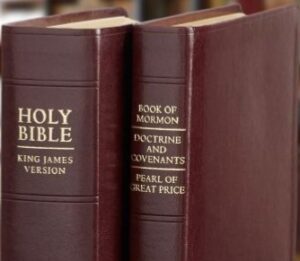
We continue our series on Mormons and the Old Testament by discussing the King James Version (KJV) in Mormonism.
The Standard LDS Position
Joseph Fielding Smith was the grandson of Hyrum Smith (Joseph Smith’s brother) and the tenth LDS Church president (1970–72). He made the following assertion: “The Church uses the King James Version of the Bible because it is the best version translated by the power of man.”[1] LDS curriculum manuals that are currently available on their official website quote from this statement with approval.[2]
Joseph Fielding Smith’s view of the KJV remains representative of the LDS Church’s position. In 1992, their “First Presidency,” their three top leaders, issued a statement that the KJV is the Church’s preferred English version:
While other Bible versions may be easier to read than the King James Version, in doctrinal matters latter-day revelation supports the King James Version in preference to other English translations. All of the Presidents of the Church, beginning with the Prophet Joseph Smith, have supported the King James Version by encouraging its continued use in the Church. In light of all the above, it is the English language Bible used by The Church of Jesus Christ of Latter-day Saints.[3]
An article published in 2011 in the magazine Ensign reiterated that stance:
Today, English-speaking Church members use the Latter-day Saint edition of the King James Version of the Bible. Based on the doctrinal clarity of latter-day revelation given to the Prophet Joseph Smith, the Church has held to the King James Version as being doctrinally more accurate than recent versions.[4]
New Guidance about Other Versions
At the end of 2025, the LDS Church issued new guidance regarding the use of other versions of the Bible. This new guidance was a response to the increasing difficulties that members have in reading the KJV.Its General Handbook identifies the KJV as the preferred English version. It also notes that it prefers the Reina-Valera in Spanish and the Almeida in Portuguese. It states:
Generally, members should use a preferred or Church-published edition of the Bible in Church classes and meetings. This helps maintain clarity in discussions and consistent understanding of doctrine. Other Bible translations may also be used.[5]
In a separate document, the LDS Church lists six “examples of other translations (by reading level)” that members might choose for their own reading of the Bible. These are the NRSV (the dominant mainline version) and five evangelical Protestant versions (ESV, NIV, NLT, NKJV, and NIrV).[6]
No doubt many Mormons have already been reading such contemporary versions. The LDS Church's new guidelines reflect that reality and seek to maintain some controls in the matter.
Why the KJV Is Still the Official LDS Bible
Why does the LDS Church remains committed to the KJV as its “preferred” English version? The reason is that Joseph Smith produced the other LDS scriptures with the KJV Bible as its basis:
- The Book of Mormon reproduces Exodus 20, Isaiah 2–14, Isaiah 48–54, Malachi 3–4, and Matthew 5–7, matching the KJV wording of these biblical chapters nearly verbatim.
- Several of the sections in the Doctrine and Covenants (2, 45, 46, 74, 76, 77, 86, 88, 93, 107, and 113) present Joseph’s interpretations of passages in the KJV.
- The Pearl of Great Price includes two sections of the Joseph Smith Translation (JST): The Book of Moses (a revision and expansion of the early chapters of Genesis) and Joseph’s revision of Matthew 24 KJV. Additionally, the Pearl of Great Price includes the Book of Abraham which, like the Book of Moses, is based on part of Genesis in the KJV (but is not included in the JST).
LDS scholar Grant Underwood understates that matter when he acknowledges “the multitudinous ways in which the ideas, vocabulary, and verbiage of the King James Bible have influenced not only the conceptual content but the very wording of the Book of Mormon, the Doctrine and Covenants, and the Joseph Smith Translation of the Bible.”[7] Mormons generally believe that God verbally inspired Joseph to produce these LDS scriptures. Thus, all three of the LDS “standard works” outside the Bible reproduce, revise, or comment on the KJV. For this reason, the KJV remains indispensable to the study of the LDS scriptures.
A Partial Step in the Right Direction
That having been said, Mormons may be beginning to soften their past view that the KJV is the best humanly produced English version of the Bible. A news article from the LDS “Newsroom” reporting the policy change at the end of 2025 quotes Jörg Klebingat. He is a member of the Seventy, a group of LDS leaders under the apostles from around the world.
There’s a misconception that modern translations of the Bible are less than faithful to the ancient sources—that in modernizing the language, translators have compromised or dumbed down the doctrine. . . . In many cases, that simply isn’t true. Modern translators often have access to manuscripts that were not available to early translators. And most modern translations were produced by faithful scholars and linguists who are utterly convinced that the Bible is the word of God.[8]
These comments don’t go far enough. For example, virtually all modern translations are based on critical editions of the biblical texts based on numerous, and much older, manuscripts unavailable when the KJV was produced. Furthermore, modern translations do not merely “modernize the language.” Rather, they draw upon vastly increased knowledge of the ancient languages and contexts of the Bible. This enables modern translators to render the texts more accurately than was possible for the KJV. (The KJV translators, please note, did a superb job for their time.) Still, Klebingat’s comments are a welcome move in the right direction.
NOTES
[1] Joseph Fielding Smith, Doctrines of Salvation: Sermons and Writings of Joseph Fielding Smith, comp. by Bruce R. McConkie (Salt Lake City: Bookcraft, 1954–56), 3:191 (italics in original).
[2] Doctrine and Covenants Instructor’s Guide: Religion 324–325 Salt Lake City: Church of Jesus Christ of Latter-day Saints, 1981), Lesson 27, “Plain and Precious Truths Restored.”
[3] The First Presidency (Ezra Taft Benson, Gordon B. Hinckley, and Thomas Monson), quoted in “Letter reaffirms use of King James version of Bible,” Church News, June 20, 1992.
[4] Richard N. W. Lambert and Kenneth R. Mays, “400 Years of the King James Bible,” Ensign, Aug. 2011, 45.
[5] General Handbook: Serving in The Church of Jesus Christ of Latter-day Saints (Salt Lake City: The Church of Jesus Christ of Latter-day Saints, 2025), §38.8.40.1
[6] “Holy Bible,” ChurchofJesusChrist.org, n.d. (2025).
[7] Grant Underwood, “Joseph Smith and the King James Bible,” in The King James Bible and the Restoration, ed. Kent P. Jackson (Provo: Religious Studies Center, Brigham Young University, 2011), 215.
[8] “New Guidance on Bible Translations for Latter-day Saints,” Newsroom, Dec. 16, 2025.