 We saw in the first article in this series, “Mormons and the Old Testament Canon,” that the LDS Church accepts the same books in the Old Testament that are in the Jewish canon of Scripture and in the Protestant Old Testament. Their main criticism is that the canon is supposedly incomplete because it is missing a number of “lost books.” I debunked that claim in my second article. However, Latter-day Saints also express concerns about the completeness and reliability of the Old Testament text. Given that the books in the Old Testament are scripture, how accurate is the text we have for those books?
Our concern here is to understand the traditional, standard Mormon view on the subject. As we shall see, the LDS view is complex and to a great extent seemingly ambiguous. Consequently, we will have to delay critically responding to the LDS view until later in this series. Our focus in this article is on a general description and understanding of the Mormon position. As I hope you will agree after reaching the end of this article, there is significant value in the effort.
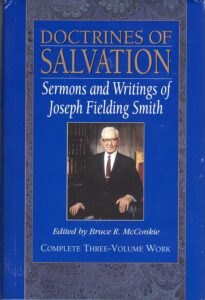
I begin by quoting again from Joseph Fielding Smith:
We are all aware that there are errors in the Bible due to faulty translations and ignorance on the part of translators; but the hand of the Lord has been over this volume of scripture nevertheless, and it is remarkable that it has come down to us in the excellent condition in which we find it. Guided by the Book of Mormon, Doctrine and Covenants, and the Spirit of the Lord, it is not difficult for one to discern the errors in the Bible.[1]
The “Excellent” Condition of the Biblical Text
The LDS Church’s criticisms of the text of the Bible need to be balanced by its acknowledgment that overall the Bible has come down to us in what Joseph Fielding Smith called “excellent condition.” Generally speaking, the LDS Church treats most of the Bible, including most of the Old Testament, as reliable both historically and theologically. LDS curriculum manuals on the Old Testament treat its historical narratives as authentic, reliable sources and its prophetic books (notably Isaiah and Malachi but not limited to them) as revelations. Quotations from the Old Testament appear routinely in LDS speeches, sermons, and publications.
Contemporary LDS scholars agree with Joseph Fielding Smith’s comment. Here is a notable example from Donald Parry, one of the leading Mormon Old Testament scholars. This statement comes in an article published in the LDS Church periodical Liahona:
When we consider the ancient methods of transmitting texts by hand, we realize that the Bible went through a remarkable process to make it into this century. The Dead Sea Scrolls stand as a witness that the Old Testament has been passed down through the centuries with a respectable degree of accuracy. For this, we must be grateful to prophets, scribes, copyists, and everyone who was responsible for the Bible’s transmission from generation to generation.[2]
Mormons have sometimes exaggerated the corruption of the biblical text. This was especially true of some early Mormon authors. W. W. Phelps, writing while Joseph Smith was still alive, commented: “As to the errors in the bible, any man possessed of common understanding, knows, that both the old and new testaments are filled with errors, obscurities, italics and contradictions, which must be the work of men.”[3] A more extreme example comes from the nineteenth-century Mormon Orson Pratt, who asked rhetorically, “Who knows that even one verse of the Bible has escaped pollution, so as to convey the same sense now that it did in the original?”[4] Some Mormons in popular discussions may make similar statements. However, the standard view that most LDS leaders and scholars express is far more positive. In discussions with Mormons who are highly skeptical about the biblical text, evangelicals may point out that their own leaders have spoken more positively on the matter.
Faulty Translations—and Transmissions
In a sense, evangelicals may agree with Joseph Fielding Smith that there are “faulty translations” in the Bible, specifically the KJV, due at least in part to “ignorance on the part of translators.” As I explained in Part 3, modern versions of the Bible (in English and in other languages) have improved on the KJV as translators have drawn on massive increases in our knowledge of the languages and contexts of the biblical texts. Even so, no English version is going to be absolutely perfect in expressing the meaning of every passage in the Bible. All informed Christians understand this point. However, in the context of their beliefs about the Bible and their other scriptures, Mormons mean something quite different.
The paradigmatic statement on the matter comes in the LDS scripture Articles of Faith (part of the Pearl of Great Price). Article 8 states, “We believe the Bible to be the word of God as far as it is translated correctly; we also believe the Book of Mormon to be the word of God.” Mormons generally don’t claim the Book of Mormon was translated perfectly. However, they do believe, as Article 8 suggests, that it was translated “correctly.” They also maintain that the Bible’s translation is seriously problematic in contrast to the Book of Mormon. The following comment by LDS apostle Bruce McConkie is fairly typical:
The Book of Mormon is translated correctly because an unlearned man did it by the gift and power of God. It took him less than sixty translating days. The Bible abounds in errors and mistranslations, in spite of the fact that the most learned scholars and translators of the ages labored years on end over the manuscripts of antiquity to bring it forth.[5]
Similarly, Ezra Taft Benson asserted: “Unlike the Bible, which passed through generations of copyists, translators, and corrupt religionists who tampered with the text, the Book of Mormon came from writer to reader in just one inspired step of translation.”[6] Notably, though, Benson mentions not just translators but also “copyists.” Here Benson makes explicit what Mormons generally understand Article 8 to mean. They think that the Bible has come down to us with errors not only of translation but also of copying or transmission. Translation in this context means rendering a Hebrew sentence in the Old Testament into English. Transmission means producing a Hebrew copy of a Hebrew text.
LDS apostle Neal Maxwell draws the same contrast between the Bible and the Book of Mormon. He states that the Book of Mormon “was not only translated by ‘the gift and power of God’; it was written and transmitted by ‘the gift and power of God.’” On the other hand, “By faulty transmission, many ‘plain and precious things’ were ‘taken away’ or ‘kept back’ from reaching what later composed our precious Holy Bible (see 1 Ne. 13:34, 39–40).”[7] Notice here that Maxwell, a well-informed Mormon leader, recognizes the distinction between translation and transmission.
Joseph Smith mentioned the same two concerns in what is perhaps his most famous statement about the issue: “I believe the Bible as it read when it came from the pen of the original writers. Ignorant translators, careless transcribers, or designing and corrupt priests have committed many errors.”[8] “Transcribers” here is another term for “copyists.” Notice that Joseph also understood and expressed the distinction between translation (done by “translators”) and transmission (done by “transcribers”).
The Original Language Texts
Mormons recognize the difference between the English Bible and the original texts in their ancient languages. Joseph referred to this difference in justification of his criticisms of the KJV:
I am now going to take exceptions to the present translation of the Bible in relation to these matters. Our latitude and longitude can be determined in the original Hebrew with far greater accuracy than in the English version. There is a grand distinction between the actual meaning of the prophets and the present translation.[9]
Of course, nothing “can be determined in the original Hebrew” unless we have the original Hebrew, at least in reliable form. Thus, Joseph’s statement presupposes that we have such knowledge of the original Hebrew text. This is why, for example, he could argue that the Hebrew word elohim should be translated “Gods.” We will examine Joseph’s argument about elohim in a separate article. The point here is that the argument assumes that the word elohim in the Hebrew Bible is the correct word.
Is the Old Testament Text Reliable or Not?
The Mormon view of the Old Testament text (as well as the New Testament text) attempts to balance two claims.
On the one hand, Mormons say that the text has come down to us in “excellent condition” (Joseph Fielding Smith). The text was transmitted “with a respectable degree of accuracy” (Donald Parry). The Hebrew text we have is close enough to “the original Hebrew” that it can be used to correct “the English version” (Joseph Smith). We should therefore be “grateful” to the “copyists” who worked so hard to preserve the biblical text (Parry).
On the other hand, Mormons criticize “generations of copyists, translators, and corrupt religionists who tampered with the text” (Benson). Joseph Smith asserted that “careless transcribers . . . committed many errors.” Neal Maxwell complains about the “faulty transmission” of the text, as a result of which “many ‘plain and precious things’ were ‘taken away’ or ‘kept back’ from reaching what later composed our precious Holy Bible.” Maxwell’s claim that the Bible is missing “plain and precious things” comes from the Book of Mormon. Mormons typically give a lot of weight to the Book of Mormon’s criticisms of the biblical text.
A similar tension appears in the LDS view of the English version of the Bible, as we saw in Part 3. On the one hand, Mormons consider the KJV “the best version translated by the power of man.”[10] It is “doctrinally more accurate than recent versions” (Joseph Fielding Smith).[11] On the other hand, they allege that the KJV “abounds in errors and mistranslations” (Bruce McConkie). The “translators” as well as transcribers “have committed many errors” (Joseph Smith).
These contrasting statements are confusing if not outright contradictory. If the copyists deliberately “tampered with the text,” should we nevertheless be “grateful” for their efforts? Does it make sense to affirm that the text has come down to us “in “excellent condition” and “with a respectable degree of accuracy,” while also saying that “many ‘plain and precious things’ were ‘taken away’ or ‘kept back’”? These seemingly discordant statements leave a lot of uncertainty as to the extent to which the texts are reliable or not.
Judging the Biblical Text by Modern Revelation
Forthcoming installments in this series will attempt to shed some light on these seemingly conflicting views. We will delve into a good number of examples of the LDS handling of the Old Testament. For now, I will offer some general explanations of these tensions in the Mormon view of the biblical text.
Historically, the contrasting assessments of the text arose from Joseph Smith’s ad hoc handling of the Bible. Where it suited him, he appealed to the existing texts, even citing the Hebrew words of the Old Testament. In other instances, he revised the texts in whatever way he saw fit. In other words, if he disagreed with the text or thought it was missing something, he felt free to criticize it and even to change it. We can see this principle in some of Joseph’s well-known statements about the Bible. The first comes from early in his career, while the second comes from near the end of his life:
“From sundry revelations which had been received, it was apparent that many important points touching the salvation of men, had been taken from the Bible, or lost before it was compiled.”[12]
“There are many things in the Bible which do not, as they now stand, accord with the revelations of the Holy Ghost to me.”[13]
Theologically, current variable Mormon views of the biblical text allow Mormons to treat it in whatever way supports LDS doctrine. Where the text seems to agree with Mormonism, Mormons assume it is reliable. Where Joseph Smith modified the text, or where it disagrees with current Mormon doctrine, Mormons assume it is unreliable. The 1992 First Presidency statement about the KJV, which I quoted in Part 3, makes this principle rather clear:
“The most reliable way to measure the accuracy of any biblical passage is not by comparing different texts, but by comparison with the Book of Mormon and modern-day revelations.”[14]
Let’s unpack that statement just a bit. By “comparing different texts” they mean comparing different ancient manuscripts of the Bible with one another and with the KJV (or other translations). Of course, that is exactly what biblical scholars do in order to pursue the most accurate text and translation of the Bible. The First Presidency statement asserts that this method is not the most reliable way to understand the Bible. Rather, one ought to compare the KJV and even the ancient language manuscripts with the LDS scriptures, which take precedence theologically over the Bible.
Here’s the bottom line. Mormonism does profess to believe the Bible. However, it judges the Bible’s accuracy and teachings based on modern revelations, not the other way around. Joseph Smith is the human origin of virtually all of those modern revelations. Thus, the LDS Church elevates Joseph Smith’s teachings above the Bible. Hence, in practice, Mormons generally consider the biblical text reliable only insofar as it agrees with Joseph Smith.
NOTES
[1] Joseph Fielding Smith, Doctrines of Salvation: Sermons and Writings of Joseph Fielding Smith, comp. by Bruce R. McConkie (Salt Lake City: Bookcraft, 1954–56), 3:191 (italics in original).
[2] Donald W. Parry, “The Dead Sea Scrolls—Window to the Modern Bible,” Liahona, Dec. 2014.
[3] W. W. Phelps, “Errors of the Bible,” The Evening and the Morning Star 2.14 (Independence, MO, July 1833): 106.
[4] Orson Pratt, Divine Authenticity of the Book of Mormon (Liverpool, 1850), 47.
[5] Bruce R. McConkie, “The Bible, a Sealed Book,” in Supplement, A Symposium on the New Testament (1984), in Teaching Seminary: Preservice Readings (Salt Lake City: The Church of Jesus Christ of Latter-day Saints, 2004).
[6] Ezra Taft Benson, “The Book of Mormon—Keystone of Our Religion,” General Conference, Oct. 1986; reprinted in Ensign, Oct. 2011, 55.
[7] Neal A. Maxwell, “The Wondrous Restoration,” Ensign, April 2003.
[8] Joseph Smith, History of the Church of Jesus Christ of Latter-day Saints, ed. B. H. Roberts, 7 vols. (Salt Lake City: Deseret Book, 1957), 6:57 (abbreviated HC).
[9] Teachings of the Prophet Joseph Smith, ed. Joseph Fielding Smith (Salt Lake City: Deseret, 1977), 290–91 (1843) (abbreviated TPJS).
[10] Smith, Doctrines of Salvation, 3:191 (italics in original).
[11] Richard N. W. Lambert and Kenneth R. Mays, “400 Years of the King James Bible,” Ensign, Aug. 2011, 45.
[12] TPJS 9–10 (1832); HC 1:245.
[13] TPJS 310 (1843); HC 5:425.
[14] The First Presidency (Ezra Taft Benson, Gordon B. Hinckley, and Thomas Monson), quoted in “Letter reaffirms use of King James version of Bible,” Church News, June 20, 1992.