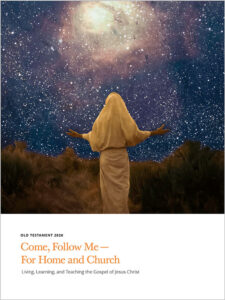
 This article is the first in a projected series on Mormonism and the Old Testament. Throughout this year (2026), the LDS Church’s official curriculum Come, Follow Me takes members through the Old Testament.[1] These articles offer an evangelical Christian perspective and response to the LDS use and interpretation of the Old Testament.
We begin by considering what the LDS Church teaches about the canon of the Old Testament. The term canon in Christian theology refers to the collection of writings properly included in the Bible or in one of its two major parts, the Old and New Testaments. As is well known, Mormonism accepts additional texts outside the Bible as scripture. In Mormon parlance, there are four collections of scriptural writings—the Bible, the Book of Mormon, Doctrine and Covenants, and Pearl of Great Price—and these are called the four “standard works.”
The LDS Church accepts within its standard works the same 39 books of the Old Testament as in the Protestant canon of the Old Testament. These same 39 books (arranged and sometimes even counted differently) are the books accepted in Judaism as the Bible since around the time of Jesus (i.e., the Hebrew Bible, also called the Tanak). Thus, in its online Guide to the Scriptures, the LDS Church’s official website states: “The Old Testament consists of the books of scripture used among the Jews of Palestine during the Lord’s mortal ministry.”[2] This same work in its entry on “Old Testament” lists those 39 books.
Curiously, the LDS Church accepts the Song of Solomon (or Song of Songs) as part of the Old Testament while denying its inspiration. According to one of its manuals on the Old Testament, “The Song of Solomon is the only book in the standard works that is considered uninspired.” This same manual quotes with approval LDS apostle Bruce McConkie’s dismissal of the Song of Solomon as “biblical trash.”[3] The denial of its inspiration originates from Joseph Smith, who commented in his revision of the King James Version of the Bible (now commonly called the Joseph Smith Translation), “The Songs of Solomon are not inspired writings.” No explanation seems to have been given for including the book in the “standard works” while regarding it not merely as uninspired but as “biblical trash.” While admittedly both Jews and Christians have struggled to understand how to read the Song of Solomon, Jews and all major branches of Christianity—Catholic, Orthodox, and Protestant—have accepted it as inspired Scripture.[4]
With that one exception regarding the Song of Solomon, the LDS Church professes acceptance of the Old Testament as both divinely inspired and historically reliable, though not as complete, inerrant, or perfect. Generally speaking, LDS leaders have faulted the Old Testament primarily for what it is supposedly missing and secondarily for its alleged inaccurate translations. Nevertheless, Mormons typically profess to have a high view of the inspiration, authority, and value of the Old Testament. The following statement by LDS President Joseph Fielding Smith, which the LDS Church has quoted in more recent publications, is representative:
We are all aware that there are errors in the Bible due to faulty translations and ignorance on the part of translators; but the hand of the Lord has been over this volume of scripture nevertheless, and it is remarkable that it has come down to us in the excellent condition in which we find it. Guided by the Book of Mormon, Doctrine and Covenants, and the Spirit of the Lord, it is not difficult for one to discern the errors in the Bible.[5]
Evangelicals agree that translations of the Old Testament have contained errors, that is, mistakes in rendering the Old Testament texts into other languages. However, in Mormon thinking, the problems go much deeper, as we will see in subsequent installments of this series.
NOTES
[1] Come, Follow Me—For Home and Church: Old Testament 2026 (Salt Lake City: The Church of Jesus Christ of Latter-day Saints, 2025). The manual is available here.
[2] “Bible,” in Guide to the Scriptures (ChurchofJesusChrist.org, n.d.).
[3] “Introduction to the Song of Solomon,” in Old Testament Seminary Teacher Manual (Salt Lake City: The Church of Jesus Christ of Latter-day Saints, 2015).
[4] For an accessible Christian introduction, see John A. Balchin, “The Song of Songs,” in New Bible Commentary: 21st Century Edition, ed. D. A. Carson et al., 4th ed. (Leicester, England; Downers Grove, IL: Inter-Varsity Press, 1994), 619. Balchin lists ten reasons to appreciate the contribution of Song of Songs to the Bible.
[5] Joseph Fielding Smith, Doctrines of Salvation: Sermons and Writings of Joseph Fielding Smith, comp. by Bruce R. McConkie (Salt Lake City: Bookcraft, 1954–56), 3:191 (italics in original). This statement is quoted with approval in Doctrine and Covenants Instructor’s Guide: Religion 324–325 Salt Lake City: Church of Jesus Christ of Latter-day Saints, 1981), Lesson 27, “Plain and Precious Truths Restored”; and in Old Testament Student Manual: Genesis—2 Samuel: Religion 301, 3rd ed. (Salt Lake City: Church of Jesus Christ of Latter-day Saints, 2003), 23.
Pingback: Lost Books? Mormons and the Old Testament #2 | Robert M. Bowman Jr. (“Rob”)Robert M. Bowman Jr. (“Rob”)
Pingback: The KJV and Other Bibles: Mormons and the Old Testament #3 | Robert M. Bowman Jr. (“Rob”)Robert M. Bowman Jr. (“Rob”)
Pingback: Reliability of the Text: Mormons and the Old Testament #4 | Robert M. Bowman Jr. (“Rob”)Robert M. Bowman Jr. (“Rob”)