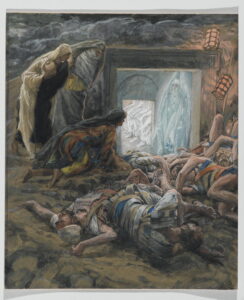
James Tissot - Women see the angel at the tomb
In observance of Holy Saturday, here is an excerpt from The Incarnate Christ and His Critics: A Biblical Defense (p. 634), which I co-authored with Ed Komoszewski, on the location of Jesus' tomb. The evidence summarized here shows that the early church retained a continuous knowledge of the precise location of the tomb where Jesus had been buried. The fact that this location was known confirms that Jesus was indeed buried in a rock tomb, just as the Gospels report. In turn, of course, this evidence supports the report that the tomb was discovered empty. And this is just one piece of the evidence!
= = = = = = = = = =
Archaeologists are virtually unanimous that the Church of the Holy Sepulchre, first built by order of Constantine in the fourth century, was built in the immediate vicinity of the tomb and very likely directly over the tomb, as traditionally believed. The church was built over an ancient quarry where half a dozen or more tombs had been built in Jesus’ era. This discovery confirmed that the church’s location stood outside the city walls when Jesus was crucified, just as the Gospels say (Matt. 27:32–33; Mark 15:20, 22; Luke 23:33; John 19:17; see also Heb. 13:12). A stratum or layer of earth just above the former quarry shows traces of fields or gardens, consistent with the reference to a garden in John 19:41.[1]
During the reign of Herod Antipas II in AD 41–44, only about a decade after Jesus’ death, a new wall was built further out that extended the city limits to include the area where those tombs were located.[2] Yet Christians in the fourth century identified this location as the place where Jesus had been crucified and buried. If they had been guessing, they would surely have guessed somewhere outside the known perimeter of the city in the fourth century. Evidently, they were not guessing.[3] Jerome Murphy-O’Connor, an expert on the archaeology of Jerusalem, has shown that there is good evidence that Christians retained knowledge of the location of Golgotha and the tomb of Jesus from the first to the fourth centuries.[4]
[1] Marcel Serr and Dieter Vieweger, “Golgotha: Is the Holy Sepulchre Church Authentic?” Archaeological Views, BAR 42, no. 3 (May/June 2016): 28–29, 66.
[2] Katharina Galor, “The Church of the Holy Sepulchre,” in Finding Jerusalem: Archaeology between Science and Theology (Berkeley: University of California Press, 2017), 137.
[3] Cf. Craig S. Keener, The Gospel of Matthew: A Socio-Rhetorical Commentary (Grand Rapids: Eerdmans, 2009), 695.
[4] Jerome Murphy-O’Connor, “The Argument for the Holy Sepulchre,” RB 117, no. 1 (2010): 55–91.