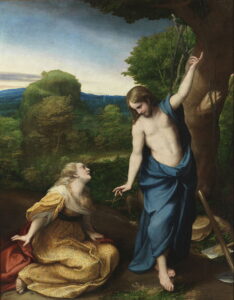
Correggio, Noli Me Tangere (c. 1525)
Today is Resurrection Sunday! As a follow-up to my article yesterday on the authenticity of Jesus' burial in a rock tomb, here is an excerpt from The Incarnate Christ and His Critics: A Biblical Defense (p. 635-36) on the role of women in discovering Jesus' tomb to be empty.
= = = = = = = = = =
Women as the First Witnesses to Find the Tomb Empty
All four Gospels report that a group of women first discovered that the tomb was empty (Matt. 28:1–7; Mark 16:1–7; Luke 24:1–7; John 20:1–2, 11–13). The prominent role of women in this event, like the role of the Sanhedrin member Joseph in providing the tomb, is another detail that would have been somewhat embarrassing for first-century Jewish men proclaiming the event, due to their patriarchal assumptions and often demeaning view of women. The Gospel writers would not have invented this detail if they were making up or repeating fictional stories.
The point here must not be overstated by claiming that men in ancient Jewish culture never accepted the testimonies of women. Rather, men tended to downgrade the value of women’s testimonies as compared with men’s, especially in certain matters. As Michael Licona puts it, “What can be stated with certainty is that a woman’s testimony would have been less preferable to a man’s, whether or not it may have been allowable.”[1] Although there are some later Jewish sources allowing that women could provide testimony in legal matters, even these sources indicate some devaluation of women’s testimonies.[2]
We find a low view of women’s testimonies reflected in Luke’s narrative account of the male disciples’ reactions. According to Luke, when the women reported the empty tomb and the angels’ message about Jesus being risen from the dead, the men thought it was “an idle tale” (Luke 24:11). Just to be sure, though, Peter ran to the tomb to see for himself (v. 12). Bias against women’s testimony likely also explains why the role of the women was not mentioned in Luke’s reports of the apostles’ speeches about Jesus’ death, burial, and resurrection (see Acts 2:29–32; 10:39–41; 13:29–31). Since Luke mentions women prominently in his own narrative of those events (Luke 23:49, 55–56; 24:1–11, 22–24), his omission of any such references in the apostolic speeches is evidence for the authenticity of those speeches. Similarly, Paul does not mention the women in his list of Jesus’ resurrection appearances (1 Cor. 15:3–8).
The woman whom all four Gospels mention went to the empty tomb was Mary Magdalene. Not only was she a woman, but she was reportedly a former demoniac, as Luke himself tells us (Luke 8:2). Now this is really poor “salesmanship” if the empty tomb is fiction. We may consider it certain that Mary Magdalene was indeed one of a group of women who went to the tomb early that morning and found it empty.
Of course, modern people should have no trouble at all recognizing that a woman’s testimony should be taken just as seriously as a man’s. The point is that this ancient prejudice (of men, naturally) is good evidence that the Gospels’ accounts of women going to the tomb and finding it empty were not inventions but facts that the authors faithfully reported.
NOTES
[1] Michael R. Licona, The Resurrection of Jesus: A New Historiographical Approach (Downers Grove, IL: InterVarsity Press, 2010), 352; see his helpful discussion, 349–55.
[2] E.g., in the Babylonian Talmud, Sotah 31b, where a rabbi is quoted as saying that under some circumstances the testimony of a hundred women could not negate the testimony of one man.